Google
 
Showing posts with label Sweden. Show all posts

Sunday, January 13, 2008

Murder and Madness, Swedish Style

Crime fiction master Henning Mankell starts and ends Before The Frost (BTF) with some serious and largely American tragedies: the Jim Jones/Jonestown affair and 9/11, but the story largely takes place in Sweden. A familiar friend to fans of international crime fiction, police inspector Kurt Wallander, is joined in this novel by his daughter, Linda, who recently graduated from the police academy. Linda is in a sort of suspended-animation, living with her Dad and waiting for the budget to be freed up so she can start work as a police officer. Linda will work out of the same police station in Skane as her Dad, and this book has a lot to say about father-daughter relationships- one theme involves Linda's long-time friend Anna and Anna's father, who abandoned the family 24 years earlier.

One pleasure of the book is a re-acquaintance with officer Stefan Lindman, whom I first met in The Return of the Dancing Master. However, the story itself is sobering. Though murder and disappearance occur throughout, they are also accompanied by cults, religious fanatics, infanticide, lies, and issues of how well we really know anyone.

The book is complex, but not needlessly so. Some events are not linked to the main thread in the way one might expect, and Linda shows her innate intelligence, as well as her inexperience, while pursuing various clues and crimes before she officially puts on the police uniform. Linda jumps into the fray because her friend Anna disappears shortly after mentioning a glimpse of her long-absent father in a nearby town. This is a claim that Linda has trouble believing.

Linda accompanies her own father to several crime scenes and to interview witnesses, initially more by coincidence than design. Linda's involvement increases out of necessity as the crimes begin to escalate, Anna's disappearance grows more troubling, and even more people disappear. Linda also travels around Sweden and to Denmark in search of answers about her missing friend, putting herself at risk and being assaulted several times. Linda is afraid now and then, but she has the determination of her father, and fights through encounters with thugs, steel hunting traps, and Christian terrorists (and no, they aren't a fictional construct outside of Northern Ireland).

During the story, we learn about Linda's troubled teenage years, two suicide attempts (one of which was very serious), her struggles with both parents (before and after their divorce), her failed relationships with boyfriends, and her decision to change careers and join the police. In spite of these difficulties, Linda grows closer to her father in many ways as they pursue the case.

There are no easy answers for the Skane police force or its Baker Street Irregular, Linda, on this case. The contributions of many, including colleagues who don't like each other, help at various stages, and Kurt orchestrates the team with his usual, gruff skill. Ultimately, however, the story and final triumph are Linda's, even if the victory is partly hollow because of the story's casualties.

I've read a lot of Mankell's books now, including Faceless Killers, The Fifth Woman, The Dogs of Riga, The White Lioness and more. The books can be very violent at times, but Mankell never exploits the violence by overdoing things, he only introduces violence that is integral to the stories. These novels maintain a very high quality and never rehash the same territory. In his books, Mankell doesn't shy away from moralizing about intolerance, greed, selfishness, neglect, fanaticism, racism, fascism and more, but he usually has a pretty light touch with the moralizing. Kurt Wallander himself is refreshingly non-judgmental, though he meets a realistic cross-section of people from all sides of the moral universe in his police work.

Read BTF to find out who survives unscathed, who "makes it" but bears lasting scars, and who doesn't make it at all out of the tangled web.

Lost comments recovered as text (reverse chronological order):

  • James Bashkin

Peter, I agree. The last two I've read mainly deal with crime in rural or small-town Sweden, yet they manage to incorporate WW2, contemporary fascism, Jonestown, 9/11, Christian terrorists, international Christian cults, and even more. The remarkable thing is it doesn't seem forced at all. Best wishes, Jim

  • Peter
I haven't read Mankell's last few novels, but in the earlier books, I was always impressed by his ability to combine narration on international and local scales.
===================
Detectives Beyond Borders
"Because Murder Is More Fun Away From Home"
http://detectivesbeyondborders.blogspot.com/


  • James Bashkin

Thanks so much, Chhaya! Yes, definitely friends. I'll reply in blogcatalog, too.

  • Chhaya
even tough i write mostly romance, i NEVER read it. i love reading the criminal/thriller type! so glad to have found u... friends?


Technorati Tags:, , , , , , , , , ,
Generated By Technorati Tag Generator

Sphere: Related Content

Wednesday, December 26, 2007

The Return of the Dancing Master by Henning Mankell- a Review of this Swedish Police Procedural

Swedish author Henning Mankell has become well-known throughout the world for his police procedural novels, especially those about policeman Kurt Wallander. These novels typically involve gruesome murder, but are dominated more by the inner workings of Walander’s mind and his investigation of the clues than they are by the violence that pervades, say, one of the Kenzie-Gennaro stories by Dennis Lehane.

In The Return of the Dancing Master, TRotDM, we meet a new protagonist, Stefan Lindman. Lindman is a fairly young, though experienced, policeman who is greeted by two sets of bad news rather early in the story: he has a cancerous tumor in his throat that requires him to start chemotherapy in a few weeks, and Herbert Molin, his old partner and one-time mentor, now an elderly, retired policeman, has just been murdered in the remote area of northern Sweden to which Molin had retired.

Understandably beset by malaise, Lindman has trouble communicating with his girlfriend and doesn’t really want to talk to anyone about his condition or his possibly-impending demise. Instead, he feels like hopping on an airplane to the Spanish coast to drown himself in pity and alcohol in the company of strangers. However, as disconnected as he feels from reality, suffering what he thinks of as an old man’s disease while only 37, Lindman is roused by the tragedy of his partner’s murder, and ultimately decides to visit the scene of the crime during his medical leave, until it is time to start chemotherapy.

As everywhere, matters of protocol and jurisdiction must be followed in Swedish police procedures, and Lindman has every intention of doing so, but, since he is really just curious as a friend, he ends up at the actual murder site before contacting the local authorities. Lindman’s instincts as a detective kick in, and he notices a few things that had been overlooked by the local officers. This infraction against protocol earns the immediate resentment of the regional commander, but Lindman eventually finds an ally in the form of the highly effective, if somewhat oddly named, inspector Giuseppe Larsson of the Ostersund police force. Larsson is an intelligent man, and is grateful for the presence of Lindman, who not only continues to find evidence that had been overlooked, but serves as an excellent sounding board for theories. The two become de facto partners, while needing to hide this collaboration from higher authorities.

So, you ask, “What is unusual about this book? It seems to follow a relatively common formula…” I can assure you that the book is not common nor formulaic, however. It turns out that almost nothing and nobody, except Giuseppe, can be taken at face value here. The partner that Lindman thought he knew turns out to have had a hidden life, a life that terrified him, and which may finally have caught up with him. The killing itself is carried out by torturing Molin to death, and the circumstances are truly bizarre.

In the course of assisting the local police, unofficially, with their inquiries, Lindman uncovers facts about his own life and family that are profoundly disturbing, just as he uncovers facts about the existence of a neo-Nazi organization that is by no means a group of mere skinheads, but is a sophisticated and well-funded network.

In the Afterward, Mankell makes the usual disclaimers about TRotDM being a novel rather than a description of actual events and people, but he also says that, intermingled with the fiction, there is a set of truths, placed intentionally, for a purpose. These truths were as disturbing as they were illuminating. Although I have read extensively about the Second World War, I was completely unfamiliar with any close connection between some segments of Swedish society and the Nazi Party. However, this connection did exist, and more than a few Swedes served under Hitler as volunteers. In TRotDM, we learn about these wartime allegiances and how they may have survived to the present day. Of course, many Swedes also helped rescue Jews fleeing the Nazis, so this is no simplistic story, either in the book or in history itself.

The revelations about Fascism in Sweden come as a shock to Stefan Lindman. Able to work at the fringes of the investigation, he manages to employ unorthodox police procedure and to pursue possible tangents that end up becoming central to the story. Through Stefan’s eyes and ears we learn much about isolated Swedish villages, the varied terrain, the good-hearted people who live far from the bustle of cities, and the evil ones who might show up wherever a rock is overturned, be it at the side of a country road or in the confines of a modern business park. The book provides maps to help us follow all of Stefan's travels across Sweden.

The story is one of revenge, of the Holocaust, of wartime cruelty and long-delayed peace-time repercussions, of skin-heads and businessmen with the same agendas (if not tactics), of the repressed and suppressed memories of Swedish-Nazi collaboration, of how that collaboration may be continuing at this very moment, and of how this knowledge repels and horrifies the modern-day police investigators, who view Sweden as a peaceful country and who learned in school only of its careful neutrality during the war.

In the case of TRotDM, the policemen face a number of dilemmas, not the least of which is “What exactly the heck is going on? Are the murders connected? Is there a lone killer, a group of killers or several unrelated killers?” The revelations about complicity and duplicity take a good while to be completed, and we meet many well-drawn characters along the way. The young girl who works as a hotel clerk and waitress is a minor character, but she is very much alive. Life goes on, and sometimes stops, in small villages as it does everywhere else, regardless of what external circumstances may intrude.

Of particular interest, we are given entrée to the mind of a killer who was bent on taking revenge for war crimes against his Jewish family no matter what the cost– revenge he has been fixated on for more than 40 years. Nonetheless, this man is troubled by guilt about a number of things, though not the execution of his intended victim. This guilt causes the killer to stay in the area, at great risk to himself, to discover what forces may have been unleashed by his act of revenge.

Judging Herbert Molin’s killer is no easy task, even for his official pursuers, the policemen Stefan and Giuseppe, and even though the costs of his crime include many unintended consequences: a pleasant country constable ends up shooting someone dead and never really recovers from the experience, and other murders are committed. As the story unfolds, the killer must evade police dogs and police cordons, and a fascist group that is determined to trap and exterminate him.

Caught up in the crimes, Stefan is largely able to forget his fears of death and throat cancer while he works in tandem with Giuseppe to peel back every layer of the mystery, though, at night, when he is alone, the fears usually return.

Is it acceptable to take “an eye for an eye”? Clearly not in the view of Swedish law, which, like most developed nations, does not allow capital punishment. But is it acceptable under some circumstances? Stefan and Giuseppe must answer this question very specifically as the mysteries are wrapped up, just as they must acknowledge the hidden and shameful past that haunts a part of the Swedish soul, perhaps even with living ghosts. Author Mankell provides us with everything we might want in a novel, and adds extra elements that give the book an unusual resonance: suspense that ebbs and flows; human frailty and courage; stark terror; the remorse associated with unintended consequences of one's actions; historical fiction that exposes the (unfortunately, all too common) savage secrets of nominal wartime neutrality; several likely and unlikely comradeships; a backdrop of Swedish villages and beautiful lodges; and wonderful language.


Technorati Tags:, , , , , , , , , , , , ,
Generated By Technorati Tag Generator

Sphere: Related Content

Sunday, September 23, 2007

No crime at all. Review of "To The Hermitage" by Malcolm Bradbury and The Eight by Katherine Neville


To The Hermitage (TTH) by Malcolm Bradbury is a most rewarding, if occasionally challenging, book. It contains two parallel stories. One story describes the great French philosopher and intellectual Denis Diderot, contemporary of Voltaire's and author/editor of the monumental Encyclopedia, finally making the perilous journey in 1773 from Paris to St. Petersburg. With this trip, he is fulfilling his long-avoided promise to visit Catherine the Great, who had purchased his vast library for her collection. The other story is a modern academic/artistic pilgrimage, The Diderot Project, following partly in the philosopher's footsteps to St. Petersburg on the eve of violent social change in Russia (in 1993).

One odd thing is that I read Katherine Neville's The Eight while reading TTH, and they had many of the same characters, in addition to having the same sort of temporally-split story line featuring contemporary and 18th century settings. The Eight is a thriller that mixes old myths, chess and modern intrigue. It pre-dates The Da Vinci Code by many years (published in 1988) and is quite well written, only losing some taughtness of storyline towards the end. What TTH and The Eight have in common is a large number of real historical characters, and reading them nearly simultaneously helped me recall or learn some history through immersion in Europe before (1773) and during (1789) the French Revolution.

What does one feel on first looking into a 500 page novel about a philosopher and some academics and sundry artistic types? I could admit to a little trepidation, even being a huge fan of Bradbury's. Luckily, the author put me at ease immediately, after a brief introduction, with an uproariously hilarious Chapter One. It begins with the remarkable shell game played on our modern narrator, an English novelist, by a delightful Swedish bank teller, who reduces a decent amount of English money to a tiny number of American dollars by a process of charging tax at every possible opportunity (and some that seem impossible). The bank converts everything to Swedish kronor both coming and going . All of this is done while denying the validity of credit cards (in 1993!) and offering the most cheerful, beautiful, blond, blue-eyed smiling face. The IRS might want to note the deadly tactics.

A series of initially confusing chapters take place THEN, with the great philosopher, but these are sandwiched in between each chapter taking place NOW, where we are treated to the most accessible and frequently funny assemblage of Diderot Project members and their subsequent departure on a ship to St. Petersburg. The events leading up to departure include a continual comedy of manners and errors, starting with

  • A futile search of Stockholm for René Descartes’ tomb
    • It turns out that Descartes died in Stockholm, but the journey that his remains took outdoes even the Australian Philosophers' Song for Groucho Marxian hilarity (see the link for lyrics or YouTube for audio/video). Trying to trace the remains of M. Descartes could reduce a man to tears.
  • An extraordinarily chilly reception by our English narrator's Swedish hosts, the married couple Bo and Alma Luneberg (Bo is on the committee for the Nobel Prize in Literature, and it is part of his job to give false hope to writers everywhere, as sincerely as possible).
    • Alma essentially says, "we would have been happy to bring you to our home for dinner instead of to this crummy little restaurant, but in Sweden, we keep our homes for our real friends." Such warmth!
  • The absolute inability of the poor narrator to convince his hosts that, as much as he likes it, he does not want to eat herring yet again on his first day in Sweden.
Then, while we begin to develop a feel for Diderot himself and for the form his story of 1773 will take, we meet gorgeous opera singer Birgitta Lindhorst, Swedish diplomat Anders Manders, skilled cabinetmaker Sven Sonnenburg, hip American professor Jack-Paul Verso (author of The Feminists' Wittgenstein) and other project members. In spite of the battle beginning between Boris Yeltsin and hard-line Russian communists, the group leaves port to sail up the Baltic and into Russia, accompanied by a dazzling assortment of chambermaids, bartenders, exotic dancers, and waitresses, all seemingly named Tatyana.

It turns out that the 18th century was a dangerous time for philosophers: a time when Emperors and Empresses needed the great men as advisers in court, but given the nature of the advice and nature of the men, a time when the philosophers often wound up in prison.

So it is with some justified fear that Diderot allows himself to be delivered, through a painful journey, to the court of Catherine. He proceeds to write a treatise on how to improve Russia, which he delivers once a week in written and spoken form to the Tzarina (I paraphrase):
  • "What, you want me to free the Serfs? Are you mad? They would rise up against me!"
  • "But no, Your Most Imperial Majesty, they would not, because of the extreme gratitude they would owe you. They would be your loyal servants."
  • "They are my loyal servants now, with no option to be otherwise. I think it is better. Let us discuss something else- reform of my police force, perhaps."

So we find in Diderot quite an American sense of Democracy, one might say.

As the modern Diderot Project members travel to and around St. Petersburg, its members become rather dispersed, and the concept of The Project seems to crumble due to the combined and contradictory pressures of, for example, the charming Tatyana from Puskin and the thrilling examination of the remains of Diderot's library. The discovery of volumes signed by Diderot, with extensive notes in the margins, and similar volumes with Voltaire's imprint, is, to our novelist, like discovering the lost library of Alexandria. Jack-Paul Verso's discoveries tend more towards Pushkin, and I don't mean the author!

I find that in trying to capture the book I can only come up with a pale imitation of the original, so, enough with the synopsis! Suffice it to say that there are long discussions, practical, theoretical, and always with a hint of danger, that occupy Diderot and his patron, and Denis is quite happy to depart home for France as long as he doesn't have to worry about being executed for treason when he arrives. He achieves his goal eventually.

At the same time, the apparently disintegrated Diderot Project really ends up providing each member with what (or whom) he or she sought. Plans are already being drawn up for a second Project, if only, Alma reminds everyone, they would write their papers on Diderot before arriving, next time.

So what is the bottom line? This book might not be for everyone, but if you have a love of history, or philosophy, or writing, or language, and a desire to learn a bit about vastly disparate European cultures while laughing quite a lot through the nervous times of the 1770's and 1990's, pick it up right away.

© James K. Bashkin, 2007

Technorati Tags:, , , , , , , , , , , ,
Generated By Technorati Tag Generator

Sphere: Related Content

Friday, September 14, 2007

Connections to Swedish Crime Author Henning Mankell


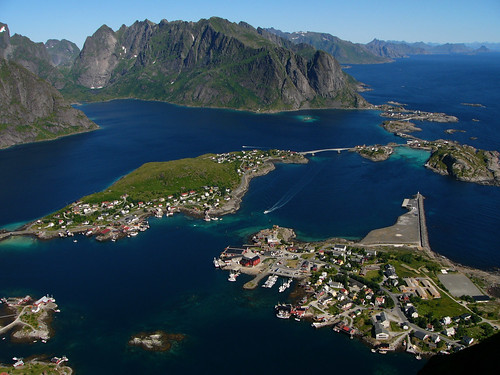
Reine, in the Lofoten Islands, Norway, reproduced by kind permission of the photographer, Joep van Wyk

Typing Henning Mankell into the literature map showed the following “connected” authors whose work I have enjoyed, but whom I haven’t yet written about. The authors are apparently connected by their readership (us), though I don’t know where the data come from. I’ve listed books I can recommend, where practical.

I became so intent on bringing up the next author, Karen Fossum, that I inadvertently switched nationalities for Mr. Mankell on the original title to this post. He is not Norwegian.

Karin Fossum (Don’t Look Back is a must read. Set in Norway, the story is in keeping with the Scandinavian theme in recent discussions with Peter and friends on Detectives Beyond Borders). I know Norway to some extent, having been there in summer and in winter, and I wanted to give people at least a brief glimpse of it. Norway is a beautiful country, so much so that there is little reason to leave a town or region once you have arrived, so don’t rush through too quickly if you visit. The Lofoten Islands are a remarkable place in a country where mountains, fjords and the sea conjure magic at every turn. You can hike up a mountain and see vistas where high mountain lakes merge with the sea, as if lake and sea formed one continuous sheet of flat water, even though the drop to the sea is 400 ft or greater.


Minette Walters (The Sculptress, which really scared me, The Echo, The Scold’s Bride, The Ice House)

James Ellroy (earlier work- the latest phase has been too rough for me to digest)

Eric Kästner (I loved Emil and the Detectives and the sequel, Emil and the Three Twins, as a boy)

T. Coraghessan Boyle (truly brilliant with words, a virtuoso; Sorry Fugu from T.C. Boyle Stories is a favorite short story, also found in The Collected Stories of T.Coraghessan Boyle)

Patricia Cornwell (the early to mid-series Kay Scarpetta books are great; Southern Cross is often hilarious)

Dick Francis, Jeffrey Deaver, Agatha Christie (I don’t imagine I could read her books today), Barbara Vine, Ruth Rendell, Ken Follet.

Another author from my past who showed up on the literature map, and whom I recommend completely, is Eric Ambler.


Technorati Tags:, , , , , , , , , , , , , , , , , , , , , , , , , ,
Generated By Technorati Tag Generator

Sphere: Related Content

ShareThis

 
*